

From Karyn M. Dyehouse, MD, Medical Oncologist/Hematologist and Chief Medical Officer, OHC
December 1, 2017

Karyn M. Dyehouse, MD
Oncologist/Hematologist and Chief Medical Officer, OHC
The American Society of Clinical Oncology (ASCO) recently issued a statement on the connection between alcohol consumption and cancer risk. In the statement, ASCO outlined proposals for promoting awareness of the association, supporting research on the association, and reducing alcohol-related cancer risk. At OHC, we agree that there is a strong connection between alcohol and cancer, and we support ASCO’s proposals.
Alcohol consumption is an established risk factor for several cancers.
- It is estimated that 5.5% of all new cancers worldwide in 2012 were attributable to alcohol
- 8% of all cancer deaths worldwide in 2012 were attributed to alcohol
- In the United States, it has been estimated that 3.5% of all cancer deaths are attributed to alcohol consumption.
- Alcohol consumption has been causally associated with oropharyngeal and laryngeal cancers, esophageal cancer, breast cancer, colorectal cancer and hepatocellular carcinoma.
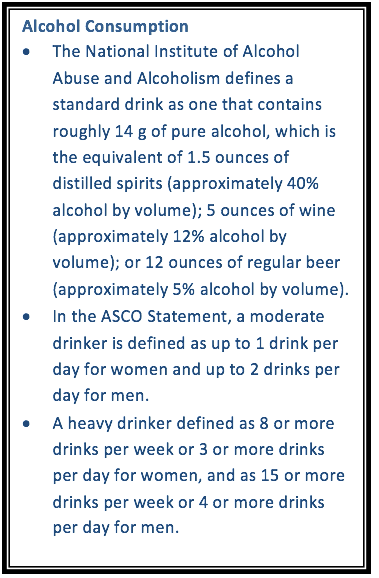
According to ASCO’s statement, the risk for cancer significantly increases even with modest use of alcohol. And it increases further with heavy, long-term consumption. For example, for oral cavity and pharynx cancers, the relative risk is 1.13 for light drinkers, 1.83 for moderate drinkers, and 5.13 for heavy drinkers 5.13. For esophageal squamous cell carcinoma, the relative risk is 1.26 for light drinkers, 2.23 for moderate drinkers, and 4.95 for heavy drinkers.
The good news is that alcohol consumption can easily be modified (except in the cases of addiction), and ASCO is proposing the following steps to help:
- Promote public education about the connection between alcohol abuse and the risk of certain types of cancer
- Support policy efforts that have been proven to reduce the excessive use of alcohol
- Provide education to oncologists about how excessive alcohol use can increase the risks of getting cancer and how it can affect cancer treatment
- Identify areas where more research is needed regarding the relationship between alcohol use and cancer risk and outcomes.
Research Needs
ASCO believes the most urgent research needed is for a better understanding of the effects of alcohol use while a patient is receiving cancer treatments, including chemotherapy, radiotherapy, and surgery, and the how alcohol might effects treatment outcomes.
Public Health Strategies
The ASCO committee stresses that excessive alcohol use can delay or have a negative impact on cancer treatment and that reducing high-risk alcohol consumption constitutes cancer prevention. Joining other cancer care and public health organizations, ASCO supports a number of strategies to prevent high-risk alcohol consumption. One of the most interesting is ASCO’s support of efforts to eliminate “pinkwashing” from the marketing of alcoholic beverages. Pinkwashing is a form of “cause marketing” characterized by a company using the color pink or pink ribbons to show commitment to finding a cure for breast cancer. As stated by the authors: “Given the consistent evidence that shows the link between alcohol consumption and an increased risk of breast cancer, alcoholic beverage companies should be discouraged from using the symbols of the battle against breast cancer to market their products.”
Role of the Oncologist
The ASCO statement says that as oncologists, we have a major role in efforts to reduce alcohol-related risks, and we agree. As front-line providers, we educate our patients on the risks and potential effects of alcohol on their treatment. We also talk about the risks of alcohol consumption at community events and other speaking engagements in an effort to raise awareness. And we plan to do even more.
Sources: American Society of Clinical Oncology (ASCO) as reported in the Journal of Clinical Oncology by Noelle K. LoConte, MD, of the University of Wisconsin, Madison, and colleagues.
