
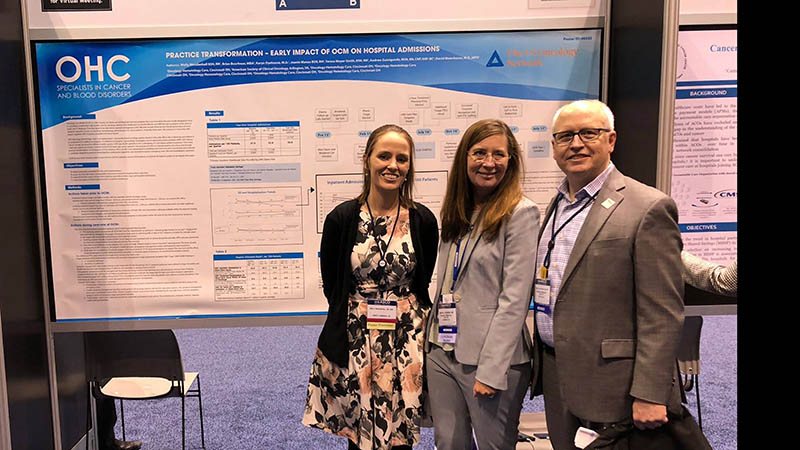
From Karyn Dyehouse, MD, medical oncologist, hematologist and Chief Medical Officer at OHC; David M. Waterhouse, MD, MPH, medical oncologist, hematologist and co-director of research at OHC; Molly Mendenhall, RN, BSN, Quality Manager at OHC
October 23, 2018

Karyn Dyehouse, MD, appeared on the Brian Thomas Morning Show to discuss the OHC initiatives and the results.
It started as a pilot created by The Center for Medicare & Medicaid Innovation (CMS) to develop new payment and delivery models designed to improve the effectiveness and efficiency of specialty care. Among those specialty models is the Oncology Care Model, which aims to provide higher quality, more highly coordinated cancer care at the same or lower cost to Medicare.
Cincinnati-based OHC (Oncology Hematology Care, Inc.) is one of only 178 cancer practices nationally to be accepted into the initiative. It is also one of the first to report positive results to national and international doctors, nurses, researchers, and quality experts. Results that include improved patient care, patient savings, and a savings of $3.2 million for CMS.
Studies have shown that 25 percent of admissions are potentially avoidable. OHC conducted a comprehensive chart review consisting of 300 cancer patient charts and found that 60 percent of those patients sought care in the emergency room without notifying OHC first.
“After our initial analysis, one of the first things we did was to identify a process that would get cancer patients the right care at the right time in the right setting when having symptoms or side effects due to their treatment,” said Karyn M. Dyehouse, MD, Chief Medical Officer at OHC. “This may sound cliché, but for a cancer patient, it can make a significant difference. When you have cancer, you are best treated by a cancer expert. And the sooner you get care, the sooner your symptoms can be controlled.”
OHC created a process which encourages their patients to call OHC before they go to an emergency room (ER). Calls are managed by certified oncology nurses and patients’ symptoms are addressed immediately through a same day office visit with a doctor, a weekend office visit, and/or counseling over the phone. After one year, OHC has reported reduced ER visits, reduced hospitalizations, and improved patient satisfaction. And a reduction in costs for patients, insurers and CMS.
“A reduction in hospitalizations means more patients are at home with their loved ones,” said David M. Waterhouse, MD, MPH, medical oncologist and hematologist at OHC, “and this is very meaningful. Advancements in patient care aren’t just about the costs of care!”
OHC also implemented proactive post-chemotherapy follow-up calls made by OHC nurse navigators to patients within 48 hours of any new treatment. These phone calls addressed symptom management and assessments to identify any new disease-related or treatment adverse events. A weekend urgent care clinic was launched on Saturdays and Sundays from 8:00 a.m. – 2:00 p.m., staffed with an advanced practice provider and registered nurses with on-site physician back-up available. Weekend urgent care services include IV treatments, IV antibiotics, full lab, supportive care measures, and outpatient blood products.
In terms of costs, using the CMS Chronic Conditions Warehouse data claims files, OHC was able to determine a baseline inpatient cost and an average year-one inpatient cost. There was a statistically significant 16% reduction in hospital admissions, which was good news for Uncle Sam, to the tune of $3.2 million in savings OHC achieved for Medicare.
“The hospital admission reductions in year one resulted in savings amounting to $798,000 in inpatient costs-per-quarter over 1,600 patients, equating to $3.129 million in savings in year one,” said Molly Mendenhall, RN, BSN, Quality Manager with OHC. “So not only are we providing better care for the patients, we’re saving them, their insurers, and the government money. It truly does come down to providing the right care at the right time in the right setting.”
The team is now on the road at national and international conferences presenting, “Practice Transformation – Early Impact of Oncology Care Model on Hospital Admissions,” which outlines the results from OHC’s implementation of the Oncology Care Model. This includes the prestigious 2018 Annual Conference of the American Society of Clinical Oncology, the Quality Care Symposium of the American Society of Clinical Oncology, the Annual Conference of the Advanced Practitioner Society for Hematology and Oncology, and this week’s Association of Community Cancer Centers national conference. Their results have also been published in the Journal of Oncology Practice.
“When chosen to present at these conference, it means you’re doing some that is very significant,” adds Dr. Waterhouse. For example, ASCO’s annual meeting is the world’s largest oncology conference with an attendance of more than 40,000 doctors, nurses, scientists, researchers and other staff to discuss the newest treatments and ongoing opportunities in the field of cancer. OHC’s presentation attracted thousands of doctors, researchers and scientists from around the world because OHC had the only presentation on the Oncology Care Model.”
The next step for OHC is threefold: continue their evaluation of the initiatives they’ve implemented, identify new ideas to further improve care and costs, and introduce genetic counseling and testing as part of the OCM model.
“Genetic testing can identify genes that could lead to cancer. That gives us an upper hand in terms of implementing preventative measures. It can also help us customize care when we know which mutation we’re dealing with,” adds Dr. Dyehouse.
Pictured, left to right: Molly Mendenhall, RN, BSN, OHC Quality Manager, Karyn M. Dyehouse, MD, OHC Chief Medical Officer, and David M. Waterhouse, MD, MPH, Co-director of Research at OHC.
