
From OHC
January 27, 2025
Head and neck cancer is a comprehensive term that includes cancer of the nasal cavity, sinuses, lips, mouth, salivary glands, throat, or larynx. It is estimated by the National Cancer Institute that 71,100 people in the US receive a head and neck cancer diagnosis each year, and unfortunately, approximately 16,110 people will die from this disease. The most common risk factors for head and neck cancer include alcohol and tobacco use, while HPV infections can also cause this devastating disease. A head and neck cancer diagnosis may start with the smallest of symptoms. For OHC patient Miesha Cole, the first symptom was a sinus infection that wouldn’t respond to medication.
“I did multiple rounds of antibiotics, but it never went away,” states Miesha, age 52 at the time. After several weeks of antibiotics, her pain radiated to her ear and her primary care physician referred her to Alter G. Peerless, MD, Mercy Health ENT physician. “For two months, while doctors tried to find the right diagnosis, the pain became excruciating,” explains Miesha.
Miesha told her doctors that she could barely function because of the pain, with even the slightest sound like a clap causing tremendous pain. “Dr. Peerless did a scope through my mouth and found ‘something back there’ which led to a biopsy,” details Miesha. “I knew they’d found something, and I got in my car and cried. I didn’t know what they found but I just felt like it was something bad.”
Things moved quickly from there. The biopsy took place within 2 days and then Dr. Peerless called in Miesha and her family. “He told us that it was cancer, and I froze. I became numb and I couldn’t hear anything else. I remember walking out and calling my girls and my family for a family meeting. We didn’t know the next steps so they tried to keep me calm,” comments Miesha.

Miesha was diagnosed with stage III squamous cell carcinoma of the oropharynx, a head and neck cancer. The tumor was in the middle of her throat, which was causing difficulty swallowing as well as eating and drinking.
The next steps included a referral to OHC radiation oncologist Courtney L. Hentz, MD for radiation treatment and OHC medical oncologist and hematologist Roma Srivastava, MD for chemotherapy. “Miesha was understandably nervous about her diagnosis, treatment plan, and the potential outcomes. We discussed her treatment plan, and I was confident that with the combined approach of radiation and chemotherapy, we could effectively treat her cancer and achieve the best possible outcome,” says Dr. Hentz.
Miesha describes her first appointment with Dr. Hentz, saying, “I met with Dr. Hentz first, and I loved her immediately. She really helped save my life. She told me when I first met her with my family, she explained everything so thoroughly. Then she said, ‘I’m going to take care of you, and I don’t miss’.”

Miesha’s treatment included concurrent radiation and chemotherapy, which started in June of 2024. Throughout her journey, Miesha needed intravenous fluids and a feeding tube to help her maintain her nutrition due to the tumor’s location. Miesha was hesitant about the feeding tube, realizing that meant she would have to give up even the simplest of tasks: feeding herself the way she was used to. ‘I couldn’t wrap my mind around it,’ she said. ‘I’m not getting a feeding tube.’ I would get upset. I ended up getting one because I had to, I couldn’t eat, but now I realize it was the best decision to make because I wouldn’t have survived otherwise.”
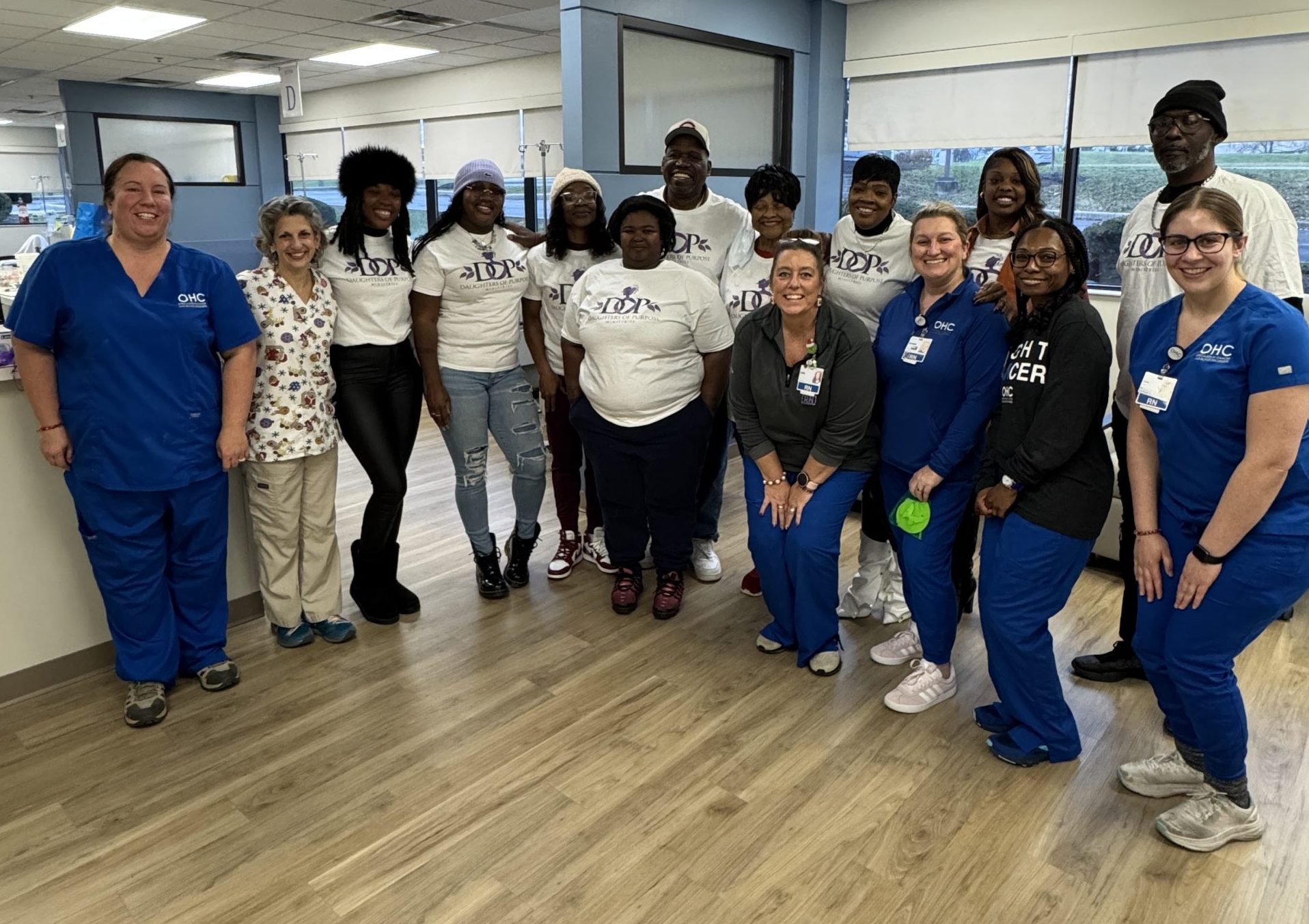
Thanks to OHC, Dr. Hentz, and Dr. Srivastava, Miesha is now cancer-free! To celebrate and thank those who participated in her care, Miesha delivered cakes to the nurses and staff at both OHC Blue Ash and OHC Kenwood. She brought her family along to participate in the celebration, thanking the staff and doctors for their dedication to her care.
“We all kept coming back to Dr. Hentz saying, ‘I don’t miss,’ and it meant so much to us to have her be so confident in my care,” says Miesha. Miesha is grateful to her OHC family, stating that everyone helped in any way they could. She explains that her daughters were the ones who stepped up and took care of her and that the OHC staff were always very good about contacting her daughters to share information, ensuring communication was strong throughout the process.
Miesha is very strong in her faith and hopes to inspire others to take charge of their own health. She says “I don’t question why. I feel like I am here for a bigger purpose, and I want to share my story to help others.”
“I would tell anyone I know, if you aren’t getting the care you need, you have to come to OHC. I can’t describe the love they have for what they do…everyone I met with from the front desk to the doctors, they made me feel like I was the only one there,” describes Miesha. “They knew what I needed, when I needed it, sometimes before I even realized I needed it.” Miesha also adds that support from her family also made the difference in her treatment, saying, “support from family, or others in your life, is so important and it had such a big part in me getting better.”
You can reduce your risk for head and neck cancers by avoiding alcohol and smoking, as well as avoiding risky sexual behavior. The HPV vaccine has been shown to reduce the risk of cervical and head and neck cancers. Review our page about head and neck cancers for what to watch out for and if you are experiencing symptoms, be sure to see your healthcare provider. OHC offers a vast variety of treatments, providing you with a personalized approach to your cancer care. If you are interested in meeting with one of our doctors or requesting a second opinion, please click here or call 888-649-4800.
